
Manage CFO Magazine: Specials Magazine
Joe Maas
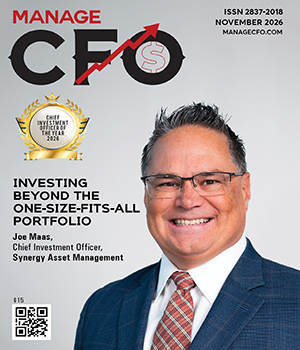
Investing Beyond the One-Size-Fits-All Portfolio
Investment management is often presented as a contest between opposites: active or passive, concentrated or diversified, risk-on or risk-off. Joe Maas has spent his career questioning whether any of these arrangements can claim a permanent advantage. Markets shift through bull, bear and sideways phases, and each changes the terms of the investment decision. As Chief Investment Officer of Synergy Asset Management, Maas believes the job is not to predict every market turn, but to understand conditions, know the client and have the right tools ready when they change. That view took shape over three decades, as successive roles steadily refined his understanding of what he owes the client. Maas, in his early days, sold insurance for John Hancock. The broker-dealer world that followed introduced a different standard, requiring investments to be suitable for the client. Becoming a CFP and moving to a predominantly fee-only practice marked a deeper shift toward fiduciary responsibility, defined by loyalty, care and a duty to follow the client’s instructions. He sees those stages as reckonings with whom his role was ultimately meant to serve. In 2001, Maas founded Synergy Asset Management, translating his fiduciary philosophy into a three-part model. The firm brought together investment management, business valuation and consulting, M&A and commercial real estate for business owners generating $5 million to $50 million in sales. For Maas, a business owner’s financial picture was bigger than the investment account. The business, its transactions and other assets mattered too. Aligning Investment Decisions with Life Goals The aftermath of the 2008 crisis exposed a basic tension in investing. Reducing portfolio risk doesn’t necessarily achieve a financial objective. While diversification and asset allocation could reduce losses, heightened risk aversion kept many investors from participating in the recovery that began in 2009. The lesson? Risk and retur
Accounting Services
Singleton Valuations
Defensible Valuations for Smarter Business Decisions
Carter Johnson, Managing Partner
Getting a high-quality business valuation shouldn’t come with a hefty price tag. Singleton Valuations strikes the perfect balance by offering expert, defensible valuations backed by data-driven precision, a flat-rate pricing model and, most importantly, the expertise of a seasoned team. Singleton specializes in M&A, partnership buyouts and internal planning, which are situations where accuracy, independent valuations and objectivity are essential. In partnership buyouts, whether planned or unexpected, it provides expert guidance to ensure a fair, well-structured exit that safeguards the company’s stability and growth. It also manages litigation, divorce cases and tax filings, guiding organizations through pivotal moments with clarity and confidence. The flat-rate pricing structure is a distinguishing feature, giving clients cost certainty and eliminating the unpredictability of open-ended fee models in the industry. “Our clients often tell us the biggest difference they experience with us is our thoroughness,” says Carter Johnson, managing partner. A trusted name in valuations, Singleton delivers clear, impartial reports that empower business owners to confidently make informed decisions. Setting it apart is its use of technology to simplify the process, reducing client workload while keeping them informed every step of the way. For business leaders juggling countless responsibilities, it ensures valuations are seamless, efficient and stress-free. Every valuation includes a comprehensive working capital analysis, showcasing the firm’s meticulous attention to detail. By identifying any excess or shortfall in working capital, a critical factor influencing business value, the assessment provides a clearer picture of operational needs and supports more accurate valuation outcomes. Singleton follows established industry standards and procedures to ensure valuations are certified and defensible. While this framework is essential, the real value comes from a customized approach tailored to each client’s business and industry dynamics. Going beyond standard practices, Singleton conducts in-depth financial analysis, including executive compensation assessments and normalization adjustments to reflect a company’s economic performance. Investments in top-tier tools and databases strengthen the precision and reliability of each valuation, offering clients a high degree of confidence in the results. Equally important is how these insights are presented. Singleton Valuations’ reports are designed in a classic and sophisticated stylish manner above the industry norm of word documents. This align with how clients want their businesses represented, especially for significant events like ownership transitions or mergers. Recognizing that every valuation serves a distinct purpose, Singleton tailors its approach to purpose-driven valuations, emphasizing partnership buyouts and internal planning. In buyout scenarios, businesses often start with a general understanding of value based on industry metrics. Many owners rely on online EBITDA multiples or benchmarks, which can be misleading. Singleton goes deeper, analyzing margin profiles, growth trends and exclusive value drivers often overlooked by general multiples. This detailed approach frequently uncovers a more accurate and higher valuation, giving clients leverage in negotiations.

Outsourced Accounting Firm

Pacific Accounting & Business Services (PABS)
Powering Next-Gen Accounting Ecosystem for Scalable Growth
Anand Tated, CEO and Founder
Accounting firms across the globe face a pivotal moment. The days of purely transactional bookkeeping are giving way to a new era shaped by real-time insights, automation, and strategic advisory services. As firms struggle with outdated systems, talent shortages, and rising client expectations, Pacific Accounting & Business Services (PABS) stands out as a partner built for the future. At the core of the company’s value proposition is its ability to manage the full spectrum of accounting operations. PABS handles catch-up and clean-up work, reconciliations, expense tracking, and tax-ready financial statements. For firms seeking comprehensive support, PABS delivers end-to-end services covering payables, receivables, reporting, cash flow management, and general ledger maintenance. Its tax preparation and audit support capabilities further strengthen its role as an extension of its clients’ teams. A major catalyst for the firm’s recent growth is PathQuest, PABS’s proprietary technology suite designed to address the long-standing inefficiencies that limit traditional accounting models. PathQuest BI [Business Intelligence], supported by an AI boost, gives firms the ability to convert raw financial data into real-time intelligence. It provides predictive forecasting, benchmarking, and multi-entity visibility, helping accountants move upstream into strategic advisory work. PathQuest AP [Accounts Payable] modernizes accounts payable through automation, fraud detection, audit trails, and virtual card support, reducing invoice processing time by up to 80 percent.
Business Valuations

How Finance Becomes the Glue in Enterprise Decisions
Jeremy Knop, Chief Financial Officer, EQT Corporation [NYSE: EQT]
Financial Risk Management

When Finance Stops Reporting and Starts Guiding the Business
Robin Boone, EVP of Finance Technology, PENNYMAC
Debt Collection

The AI Investment Paradox: Why Data Architecture Determines Roi
Darren Talham, Chief Technology Officer, Continental Finance Company, LLC
Business Valuations

Finance Leadership Beyond the Rearview Mirror
Roman Magar, VP and Director of Financial Planning and Analysis, Shore United Bank
Debt Collection

Developing the Next Generation of Financial Services Leaders in a Rapidly Changing Industry
Armel Romeo Kouassi, Senior Vice President - Global Head of Asset Liability Management, Northern Trust Corporation

IN MY OPINION
Debt Collection
Building Growth on Everyday Trust
Jane Barrett, PHR,SHRM-CP, Head of Human Resources, North America, Trident Trust

LAST WORD
Business Valuations
Relationship driven Strategy in Venture Banking
Jesse Martin, Vice President, Venture Banking – Technology, Banc of California
IN FOCUS

Tax Precision: Leveraging Automation for Effective Compliance Management
Modern tax compliance services help businesses improve accuracy, reduce reporting risks, simplify filings and adapt confidently to changing regulatory requirements.
Navigating Cash Management Challenges: Best Practices for CFOs
Effective cash management strengthens liquidity, forecasting, financial resilience, and strategic business growth for CFOs.
EDITORIAL
Aligning Investment Strategy with Long-Term Value
Featured in the cover story, Joe Maas, Chief Investment Officer at Synergy Asset Management, has been named Chief Investment Officer of the Year 2026 for his personalized, fiduciary-led approach to investment management. Drawing on more than three decades of industry experience, Maas develops investment strategies around each client’s financial goals, cash flow needs, spending requirements and tolerance for risk. Under his leadership, Synergy combines data-driven insights, disciplined portfolio management and artificial intelligence through its Lifestyle Return Benchmark and Strategically Aligned Asset Manager framework, while keeping human judgment and fiduciary responsibility at the heart of every decision.
Contributor Jane Barrett, PHR, SHRM-CP, Head of Human Resources, North America at Trident Trust, examines how trust, candid communication and practical coaching help organizations steer AI-driven workplace transformation. Her viewpoint highlights the importance of workforce development, accessible benefits education and caring leadership for building resilient teams.
Jesse Martin, Vice President, Venture Banking – Technology at Banc of California, offers insight into supporting technology companies through different stages of growth. His approach unites stage-appropriate financial analysis, capital planning and relationship-driven banking. By evaluating cash runway, revenue growth, liquidity and funding milestones, Martin helps founders consider financing options which support sustainable expansion. He additionally emphasizes resilience, capital efficiency and the value of building relationships before funding becomes urgent.
Together, these perspectives point out the interrelated nature of financial leadership. Personalized investment strategies, trusted workforce relationships and thoughtful capital solutions help organizations steer uncertainty, strengthen decision-making and pursue long-term value creation.
