
Manage CFO Magazine: Specials Magazine
CTBC Bank Corp. (USA)
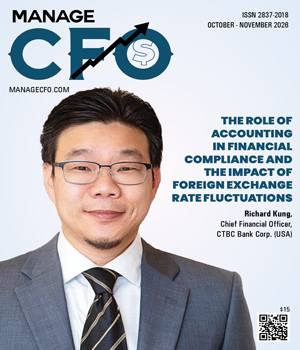
The Role of Accounting in Financial Compliance and the Impact of Foreign Exchange Rate Fluctuations
What Role Does The Accounting Function Play In Maintaining Accurate Financial Records And Ensuring Compliance With Accounting Standards And Regulations? Accounting plays a critical role. The accounting and finance teams are the foundation of the organization’s financial output. More likely than not, most individuals already use basic accounting principles, from balancing their checkbooks to managing their household cash flow. Accounting keeps current and historical information, giving users key information and an accurate picture of performance. Further, accounting consolidates revenue and expense drivers and provides stakeholders with the fundamentals, which is the first step in analyzing any Key Performance and Risk Indicators. Equally important, we focus on Basel III and the development of endgame regulations, translating development into opportunities to enhance resource utilization while optimizing capital usage. Strict adherence to accounting standards unifies the understanding of a company’s use of resources or the most basic and universal elements to a denominator. Disciplined compliance with basic standards enables a sound budgeting process, informed investment decisions, evaluation of costs and benefits, and application of tax strategies. Most importantly, observance of accounting standards ensures confidence, knowing that maintaining accurate financial records is the critical first step of accounting guiding principles for makers and checkers. If Your Company Can Consent To This, Can You Share Your Experiences From One Of The Projects You Were Recently Involved In? Accounting processes have evolved significantly over recent decades. The core is to improve the process and create efficient and effective gathering by preparing and auditing of accounting data. For our organization, there are several projects to support these goals as we deploy continuous process improvement as an internal key performance indicator. This includes implementin
Business Valuations
Grigsby Forensic & Valuation
Charles Grigsby: A 50-Year Legacy of Business Appraisal
Charles Grigsby, Founder
When it comes to finance and business, the role of experienced business valuation professionals is paramount. One such renowned industry expert is Charles Grigsby, founder of Grigsby Forensic and Valuation. His half-century of experience equips him to conduct accurate business valuations and navigate their complexities, thereby providing decision-makers with crucial insights to formulate strategies. A certified public accountant (CPA) and former IRS auditor, Grigsby applies his wealth of expertise to determine the accurate value of clients’ businesses. His meticulous valuations adhere to government agency standards, ensuring the appraisal reports are precise and reliable. Having successfully helped numerous clients make financial decisions, Grigsby’s transformative impact rightfully earned him a place among ‘Marquis Who’s Who Top Business Owners 2023’. “I strive to stay ahead of evolving methodologies and best practices to enhance the accuracy of my valuations continually,” says Charles Grigsby, founder of Grigsby Forensic and Valuation. His ongoing pursuit of prestigious university certification testifies to his dedication to continuous learning. In addition to various business valuation and forensic accreditations, Grigsby recently attained advanced valuation certification from the New York University Graduate School of Business. This instills confidence in clients, affirming them of his ability to handle diverse and complex business appraisal requirements. These global accreditations empower Grigsby to effectively serve clients across industries like agriculture, technology, and law. This extensive experience and education enabled him to develop a structured methodology, which forms the core of his business valuation process. Grigsby adeptly blends income and market approaches and applies relevant sub-procedures to infer a fair market valuation, thereby reducing the possibility of discrepancies.

Business Valuations

Monarch Business Valuations stands as a pinnacle of expertise in the complex world of business valuation. Catering to a diverse clientele that includes accounting firms, certified public accountant (CPA) firms and Fortune 500 companies, the specialty business valuation firm evaluates financials and determines fair market value for enterprises with sales ranging from a million to a billion dollars. Backed by a team of certified evaluators and CPAs, Monarch provides business owners with accurate and credible valuation information and a holistic understanding of their profit and loss statements. This empowers them to know their true market value and make informed decisions on business sales, loan applications and partnership changes. It also guides clients in analyzing valuation reports, ensuring clarity and alignment at every step, which enables them to plan for their business’s future. Going beyond valuations, Monarch offers financial rebuilding services by providing actionable insights for growth after uncovering true market value. This often results in significant increases in the business’s value, along with streamlined expenses and boosted profitability. “We delve into every aspect of a company’s operations and financials. Our goal is to comprehensively understand the client’s business and enhance its market value,” says Michael Sanborn, CEO. Operating with a keen eye for financial intricacies, Monarch assigns experts with industry-specific insight to deliver tailored valuations. Its methodology involves rigorous scrutiny of balance sheets and financial statements to ensure accuracy and compliance with regulatory standards. An example best showcases Monarch’s ability to provide strategic insights and drive tangible improvements for a rapidly expanding manufacturing firm. Despite the firm’s impressive growth, concerns arose due to declining profitability. The Monarch team’s thorough analysis revealed a crucial discrepancy—the firm’s failure to adjust pricing in response to escalating production costs, resulting in a significant financial loss. It recommended aligning pricing with production expenses and implementing operational efficiencies, which enhanced the client’s profits.
Business Valuations
Empire Valuation Consultants’ (EVC) journey to be one of the leading, most respected independent valuation consulting firms in the U.S. is truly inspiring. Founded in 1988, the company consistently demonstrated a commitment to delivering timely results and personalized attention to every client engagement from day one. An employee-owned, independent advisor without ties to accounting firms or investment banks, EVC provides shareholders of middle-market companies with the confidence and assurance they need during pivotal transactions. Valuations are grounded in robust market evidence, supported by extensive research, market insights, and financial trends, ensuring they are devoid of conflicts of interest. EVC leverages a talented network of almost 100 professionals, bringing broad operational and consulting experience to every engagement. The firm’s high-level knowledge is strengthened by CEO William A. Johnston’s teaching experience with the American Society of Appraisers and experience serving in working groups as a subject matter expert on financial reporting issues for the Appraisal Foundation. He has performed about 2,500 valuations for private and public companies, as well as the Big Four accounting firms. Unlike competitors who may delegate work to less seasoned professionals, EVC assigns experienced professionals to handle each client, maintaining team continuity year after year. Senior-level attention is given to every engagement, with managing directors heavily involved in the processes and readily available for questions. The team’s collective efforts support EVC’s competency in helping corporate businesses comply with purchase price allocations, impairment testing, stock compensation expense issues (409A and ASC 718 earn-outs, rollover equity and complex securities. Every valuation is meticulously conducted according to the requirements of the Securities and Exchange Commission (SEC), Public Company Accounting Oversight Board (PCAOB), Internal Revenue Service (IRS), and other regulatory authorities. Time and again, attorneys, accountants, estate and insurance planners, bankers, and others—from the most prestigious firms to sole practitioners—recommend and turn to EVC for a broad range of valuation needs. “No matter the complexity of the valuation requirements, EVC is equipped to deliver accurate and insightful analysis,” says Johnston. “Our capabilities span across the valuation of companies, real estate, machinery and equipment, intangible assets incentive units, rollover equity, earn-outs and much more.”

Financial

The inclusion of Risk Advisory in Financial Risk Management and Financial Fraud Detection
Mohamed Bamba, Vice President, Risk Advisory, BankUnited [NYSE: BKU]
Outsourced CFO

The CFO's Role in Recession Planning
Douglas Maxwell, Chief Financial Officer, American First Finance
Business Valuations

What To Consider When Deciding To Use A Third-Party Valuation Firm?
Michael McCoy, CFO, B. Riley Financial
Valuation Services

What is Effective Financial Risk Management?
Gilbert Asamoah, Credit Risk Manager, NiSource
Debt Collection

Why Improving the Payment Experience Can Boost Your Bottom Line
Steven Shafer, Treasury Innovations Team Manager, Bremer Bank

IN MY OPINION
Business Valuations
Unlocking The Potential of Idle Cash: Strategies and Tools for Effective Management
Ted Lane, Director of Commercial Strategies, First United Bank

LAST WORD
Business Valuations
Diversity and Inclusion in the Credit Market
Margaret Chamberlain, Vice President of Risk Management, OneAZ Credit Union
IN FOCUS


EDITORIAL
How Cfos are Shaping the Future of U.S. Markets
One of the most direct ways CFOs impact the markets is through earnings reports and financial guidance. Investors closely monitor CFO statements, as their outlook on revenue, profitability, and cost-cutting measures can sway stock performance. A strong earnings forecast can drive a company’s stock price higher, boosting market optimism, while cautious guidance can lead to sharp declines. In times of economic instability, CFOs play an even larger role in shaping market sentiment, as their insights into corporate spending and investment trends provide signals about future economic conditions.
CFOs also influence markets through their handling of interest rate fluctuations and inflationary pressures. As borrowing costs rise, they must make strategic decisions on debt management, pricing strategies, and operational efficiencies. Many companies have adjusted their financial strategies in response to the Federal Reserve’s monetary policy shifts, with CFOs leading the charge in determining whether to cut costs, expand cautiously, or pursue mergers and acquisitions. These corporate decisions, in aggregate, create ripple effects across industries and influence overall market stability.
Technology and financial innovation have further elevated the CFO’s role. Many are leveraging artificial intelligence, automation, and advanced data analytics to improve financial forecasting and operational efficiency. Their embrace of financial technology not only strengthens individual businesses but also drives investment in the fintech sector, shaping market trends in emerging technologies. Additionally, CFOs are responsible for managing risks such as cybersecurity threats, regulatory compliance, and supply chain disruptions, all of which have a direct impact on financial performance and investor confidence.
As markets grow increasingly complex, CFOs have become essential architects of financial strategy and stability. Their leadership in navigating economic challenges, managing risk, and embracing innovation makes them key players in determining the direction of both individual companies and the broader U.S. economy.
